
Autonomous AI Agents: The 2026 Guide for SMB Leaders
Autonomous AI agents are changing how small and mid-sized businesses scale. In this guide, we break down what agentic AI really is, how it works, and where it delivers real ROI for SMB operations in 2026.
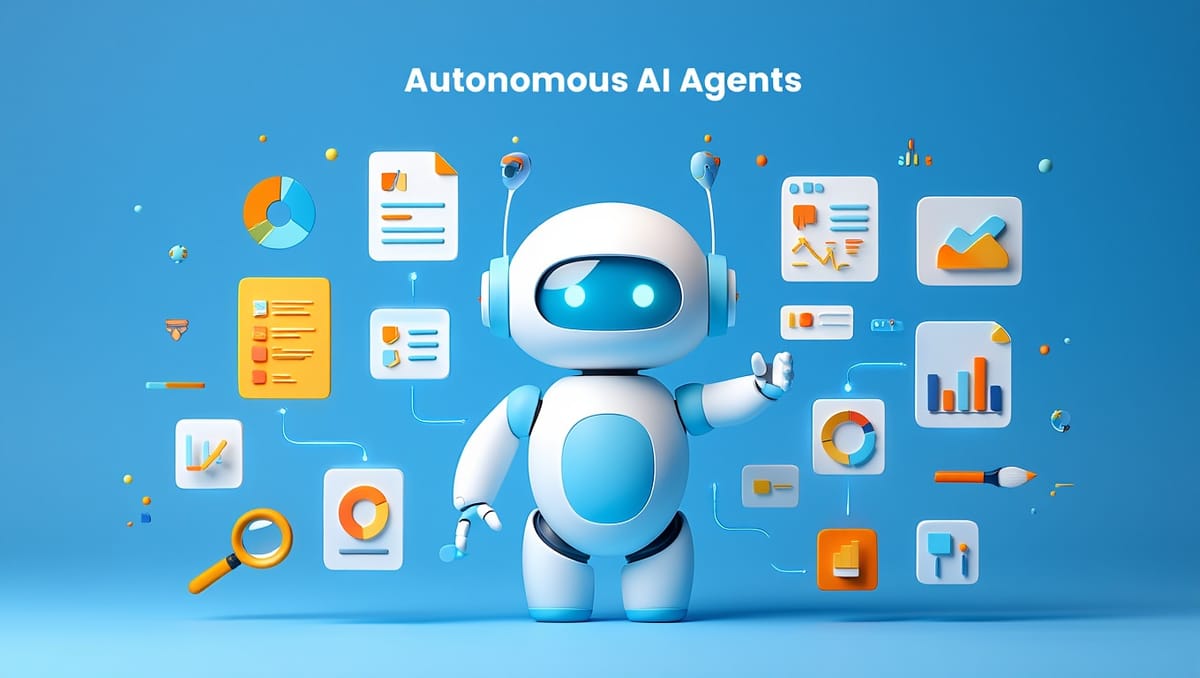
For the modern Small and Medium-sized Business (SMB), the primary constraint on growth has rarely been a lack of vision; it has been a lack of bandwidth. Historically, scaling required a linear increase in headcount. More customers meant more emails, more invoices, and more administrative overhead.
In 2026, that linear relationship is breaking. The emergence of autonomous AI agents represents the most significant shift in business productivity since the cloud. Unlike the passive AI tools of the early 2020s, these agents are designed for action, allowing smaller teams to operate with the efficiency and sophistication of global enterprises.
1.From Generative AI to Agentic AI
To understand the value proposition for your business, we must distinguish between the two primary flavors of AI currently in the market.
- Generative AI (The Advisor): These are tools like the early versions of ChatGPT. They take a prompt and generate text, code, or images. They are excellent for brainstorming but require a human to take the output and do something with it.
- Agentic AI (The Executor): Autonomous agents are goal-oriented. Rather than waiting for step-by-step instructions, an agent is given a high-level objective, such as "reconcile last month's travel expenses." It independently identifies the necessary steps, accesses the required software, and completes the task.
For the SMB owner, this is the difference between having a dictionary and having a writer. One is a tool; the other is a teammate.
2. The Core Architecture
While the underlying technology is complex, the operational framework of an autonomous agent is remarkably similar to a well-trained employee. They function through a continuous loop of four specific capabilities:
I. Perception and Data Integration
Agents do not live in a vacuum. They connect to your business ecosystem, including your CRM (Salesforce, HubSpot), your communication tools (Slack, Outlook), and your financial software (QuickBooks, Xero). They perceive your business by monitoring these data streams in real-time.
II. Strategic Planning
When a goal is set, the agent uses its Large Language Model (LLM) core to reason. If the goal is to "Onboard a new client," the agent knows it must first generate a contract, send it for signature, and then create a folder in the project management system.
III. Autonomous Execution
This is where the magic happens. Using browser-based actions or API integrations, the agent performs the work. It logs into your portals, clicks buttons, and transfers data across platforms without manual intervention.
IV. Self-Correction and Learning
If an agent encounters a 404 error or a bounce-back email, it doesn't simply stop. It attempts to troubleshoot. It might look for an alternative contact or notify you of the specific bottleneck, learning your preferences for future tasks.
At Codynex, we see most SMB failures with AI agents not at the model level, but at the workflow and integration level.
3. High-Impact Use Cases for SMB Growth
For most SMBs, the highest return on investment (ROI) comes from deploying agents in three specific departments: Sales, Finance, and Customer Experience.
A. Sales and Lead Intelligence
In a competitive market, lead response time is the leading indicator of conversion.
- The Agent Workflow: An agent monitors your inbound lead flow. Within seconds, it researches the prospect's company size, recent news, and current tech stack. It then drafts and sends a personalized introductory email that addresses the lead's specific pain points.
- The Result: Your sales team spends 100% of their time talking to qualified prospects rather than hunting for data.
B. Intelligent Financial Operations
Late payments and manual data entry are significant silent killers of SMB cash flow.
- The Agent Workflow: An autonomous agent monitors your accounts receivable. It identifies overdue invoices, checks the client’s previous payment history to determine the appropriate tone for a reminder, and sends a sequence of follow-ups. If a payment is received, it automatically reconciles it in your ledger.
- The Result: Reduced Day Sales Outstanding (DSO) and a cleaner balance sheet with zero manual effort.
C. Proactive Customer Success
Customer support is traditionally a reactive cost center. Agents turn it into a proactive asset.
- The Agent Workflow: Instead of waiting for a ticket, an agent monitors product usage or delivery statuses. If a shipment is delayed, the agent can proactively email the customer with an update and a discount code for their next order.
- The Result: Increased customer lifetime value (CLV) and reduced churn.
4. Addressing the Implementation Barriers
While the benefits are clear, a professional implementation requires a sober look at the risks.
Data Privacy and Governance
As an SMB, your data is your moat. When deploying agents, it is critical to use enterprise-grade AI platforms that offer data silos. Ensure that the information your agent learns from your proprietary files is not used to train public models. In 2026, Private AI instances have become the standard for professional organizations.
The "Hallucination" Guardrail
AI can occasionally produce hallucinations, which are factual errors presented with high confidence. For this reason, we recommend a "Human-in-the-Loop" (HITL) architecture for high-stakes tasks. An agent can draft a $50,000 proposal, but a human should always provide the final click to send.
Integration Complexity
The trend in 2026 is interoperability. Most modern agents are low-code or no-code, but they still require a clean digital foundation. If your business data is trapped in physical filing cabinets or disconnected spreadsheets, the agent’s utility will be limited. Digitization is the prerequisite for automation.
Strategic Recommendations
To avoid shiny object syndrome, we suggest a phased approach to agent adoption:
- Identify High-Volume, Low-Complexity Tasks: Look for processes that are predictable but time-consuming. These are the low-hanging fruit for AI delegation.
- Conduct a Tool Audit: Check your current software stack. Many major vendors like Microsoft, HubSpot, and Adobe have already integrated agentic capabilities into their Pro tiers. You may already own the tools you need.
- Start with Internal-Facing Agents: Before letting an AI speak to your customers, let it help your employees. Have an agent summarize internal meetings or manage team schedules. Once you trust the output, move to external-facing roles.
Conclusion
Autonomous AI agents are not a futuristic luxury; they are becoming the baseline for operational excellence. For small and medium-sized businesses, this technology provides a rare opportunity to outmaneuver larger competitors through agility and lower overhead.
The goal is not to remove the human element from your business. On the contrary, by delegating the mechanical, repetitive tasks to autonomous agents, you allow your team to focus on the things only humans can do: build relationships, think creatively, and lead with empathy.
If you’re exploring autonomous AI agents and want a realistic implementation roadmap for your business, this is exactly the work we do at Codynex.
Comments ()