
Building Production Ready AI Agents in 2026
A practical guide to architecting, securing, and scaling reliable AI agents that actually work in production
Imagine waking up to find that your AI agent has already handled hundreds of customer inquiries, scheduled dozens of meetings, and negotiated vendor contracts while you were sleeping. This level of automation is no longer science fiction but the baseline expectation for businesses in 2026.
However, there is a stark reality that often goes unmentioned: A vast majority of AI agents fail the moment they hit production.
They tend to hallucinate, time out during peak hours, or simply cost too much to run effectively. At Codynex, we encounter this challenge daily when clients approach us with fragile prototypes that crumble under real-world pressure. This guide outlines our specific engineering approach to moving from a basic demo to a robust and scalable AI workforce.
The Demo Trap vs. Production Reality
Building a production-ready AI agent is comparable to constructing a skyscraper: you need a solid foundation before you can build the upper floors. While it is easy to make an agent look smart in a controlled demo, production brings unpredictable challenges like latency spikes and context loss.
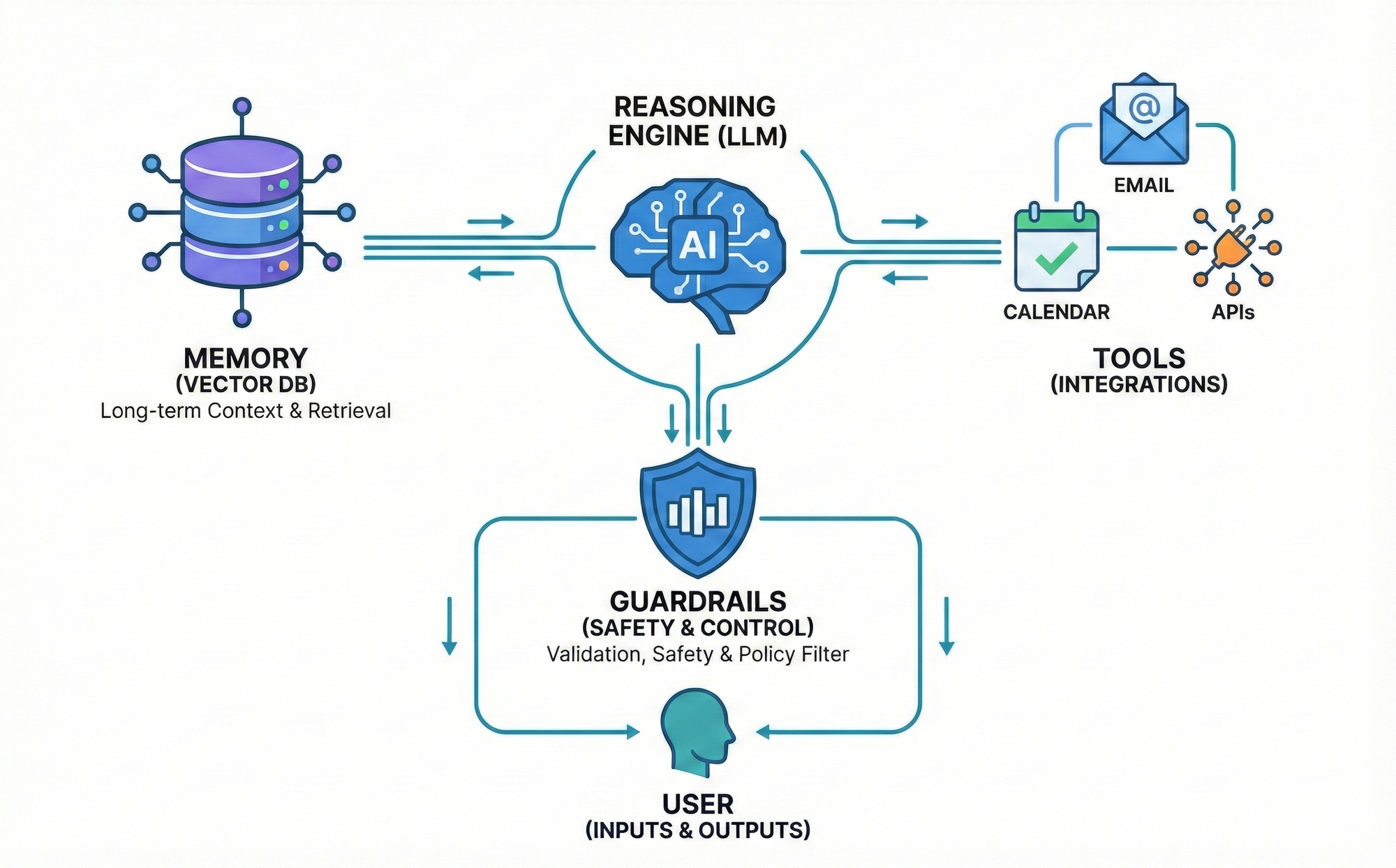
To solve this, our production agents rely on a cohesive architecture built on four distinct pillars:
- Reasoning Engine: Powered by advanced models (GPT-4, Claude), this serves as the "brain" for complex logic.
- Memory Systems: We use vector databases to recall past user interactions, ensuring the agent doesn't forget context.
- Tool Integration: This layer allows the agent to perform actual tasks, such as querying databases or sending emails.
- Guardrails: A strict validation layer that checks every output before it ever reaches the user.
Architecture Patterns That Actually Scale
If you build your agent as a single monolithic structure, it is destined to fail under load. At Codynex, we advocate for a Microservices Architecture to ensure reliability.
Synchronous API calls are the enemy of speed. Instead of making the user wait, we utilize event queues and background workers. This allows the agent to acknowledge a request immediately while processing the heavy lifting asynchronously.
Your database strategy is equally critical. A modern AI stack requires a blend of technologies:
- Vector Databases: For semantic search and memory.
- Relational Databases: For structured user data and logs.
- Semantic Caching: We store active conversation history to serve frequent answers immediately. This bypasses the need for a new LLM call, significantly reducing latency and operational costs.
Security and Protecting Your Data
Security cannot be an afterthought; it must be the first line of defense. AI agents introduce new vectors like "prompt injection" attacks that can trick a bot into revealing sensitive data.
We secure Codynex agents using a multi-layered approach:
- Role-Based Access Control (RBAC): Agents act with limited permissions. An agent designed to read tickets is physically restricted from deleting accounts.
- PII Redaction: We use intermediate layers to strip Personally Identifiable Information (like credit cards) before data is sent to external providers.
- Audit Trails: Every single decision the AI makes is logged, allowing us to trace exactly why a specific action was taken.
Observability and Deployment Strategies
A traditional web app crashes with an error code, but an AI agent can fail by simply being rude or giving bad advice. To catch these nuanced failures, you need deep observability.
We use specialized tools to track:
- Token Usage & Costs
- Latency Per Step
- Sentiment Drift (Is the user getting frustrated?)
When releasing updates, we utilize Canary Deployments. We never deploy a new AI model to all users simultaneously. Instead, we roll it out to a small percentage first. If metrics hold steady, we expand the release; if not, the system automatically reverts to the previous stable version.
The difference between a fun experiment and a valuable business asset is reliability. The technology in 2026 is ready, but the real question is whether your infrastructure is prepared to support it.
At Codynex, we do not just build chatbots; we architect digital workforces. Whether you need to automate customer support, streamline data entry, or build a custom mobile AI tool, we have the engineering rigor to make it production-ready.
Comments ()