
What Is Shopify Storefront MCP? A Plain-English Guide for Store Owners
Every Shopify store now has a Storefront MCP endpoint. Here's what it is, what it does for AI shopping, and why it matters for support.
If you've read a Shopify update this year, you've seen "MCP." It shows up in every agentic commerce headline, usually with no explanation. Here's the version for store owners: what Storefront MCP is, what it does, and what (if anything) you need to do about it.
MCP in One Sentence
MCP, the Model Context Protocol, is an open standard that gives AI assistants a structured, approved way to ask a system for information and take actions, instead of scraping web pages and guessing.
Think of the difference between someone reading your shop window and someone asking a staff member who can check the stockroom.
What Storefront MCP Is
Shopify gives every store its own Storefront MCP server. It lives at your store's address plus /api/mcp. Shopify announced it as part of its January 11, 2026 agentic commerce launch.
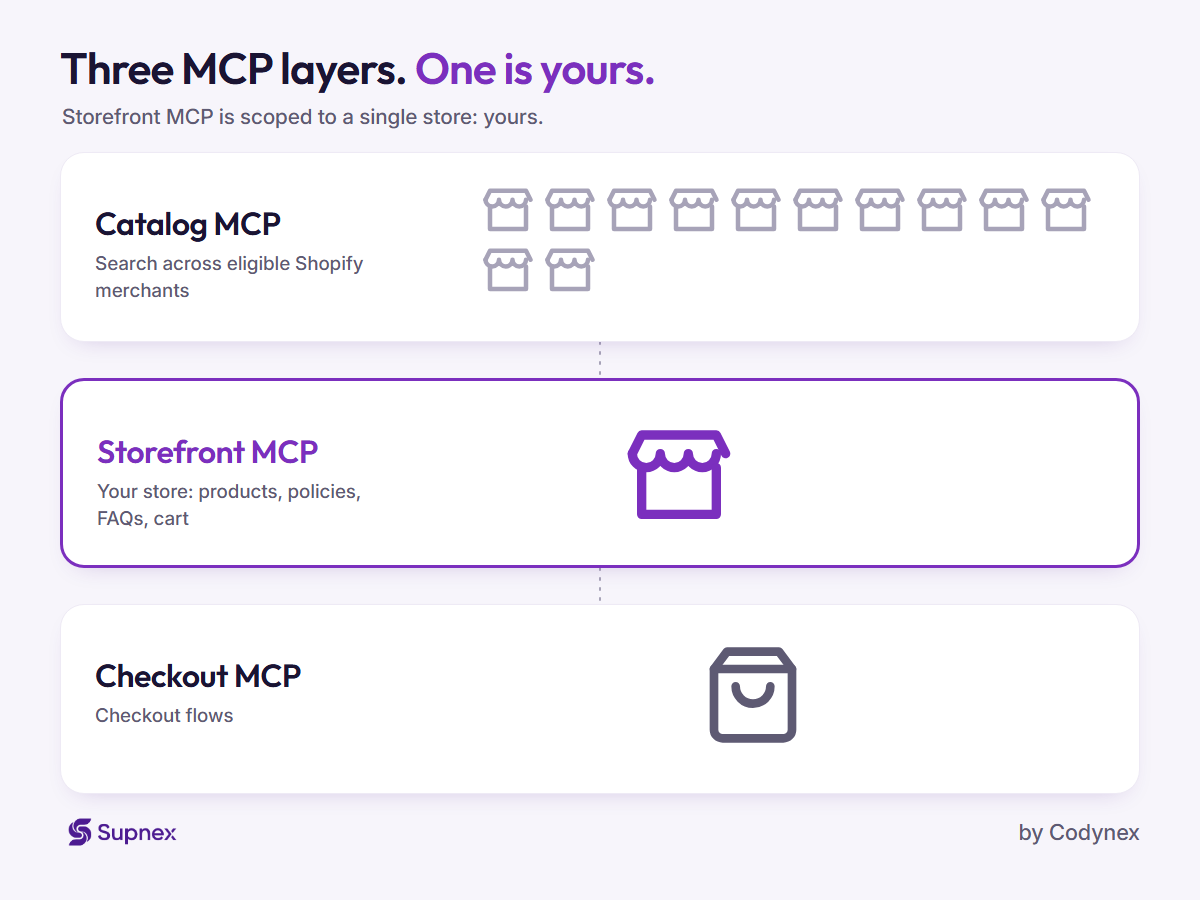
It's scoped to one store, yours. Through it, an AI assistant can do store-specific things: search your products, read your policies and FAQs, and work with a cart. Shopify's docs describe a separate Catalog MCP for searching across eligible Shopify merchants, and a Checkout MCP for checkout flows. Storefront MCP is the one about a single store.
Why It Exists
Before MCP, an AI assistant answering a question about your store had two options: read your public web pages and hope, or rely on whatever it learned during training, which could be months old. Neither is a good basis for "is this in stock in medium?"
Storefront MCP gives assistants your live, structured store data straight from Shopify. Better data in, better answers out. And it's Shopify's data, so your prices, variants and policies are the ones you set.
What It Means for You (The Practical Part)
You don't need to switch it on. Shopify provides it. If you run a Hydrogen storefront, Shopify's 2026.1.4 release proxies /api/mcp by default.
Your store data quality now matters twice as much. Anything reading your store through MCP sees exactly what you've entered. Vague product descriptions, missing dimensions and outdated policies don't stay hidden on a page nobody reads anymore. They become the answers.
It doesn't replace your checkout. Purchases still finish on your Shopify checkout and orders show up in your admin.
How Supnex Uses Storefront MCP
Supnex AI, built by Codynex, uses Shopify's Storefront MCP to ground its answers in your verified catalog, policy, cart and order context. When a shopper on your site asks "does this come in a wider fit?", Supnex isn't predicting what a typical store might say. It's checking your store, through Shopify's own interface, and answering from that.
The same layer supports Supnex's cart actions: it can add, remove or update items, and the shopper approves every change before their cart is affected. If the data doesn't support a confident answer, Supnex escalates instead of guessing.
The Takeaway
MCP sounds like infrastructure, and it is. For a store owner the summary is simple: AI now reads your store through an official door instead of through the window. Keep what's behind that door accurate, and every assistant that uses it, including your own support agent, gives better answers.
CTA: Want to see Storefront MCP-grounded support on a real store? Try the Supnex demo store at store.supnex.app, then book a live demo to see it on yours.
 Hashir Abbasi

 Hashir Abbasi



Comments ()