
On-Device AI vs Cloud AI: A 2026 Mobile Guide
Learn the critical trade-offs between On-Device and Cloud AI. We analyze cost, speed, and privacy to help you build a profitable mobile app in 2026.
The architectural choice between processing artificial intelligence locally or on a server is the most critical decision for mobile app development in 2026. Business leaders and product managers are constantly weighing the raw power of Cloud AI against the speed and efficiency of On-Device AI.
This decision impacts everything from your monthly operational costs to user retention rates. At Codynex, we help businesses navigate this complex landscape because selecting the wrong AI infrastructure can result in unnecessary latency and inflated budget requirements.
The Strategic Value of Cloud AI
Cloud AI remains the industry standard for applications requiring massive computational power and access to vast knowledge bases. When a mobile app connects to large language models like GPT-4 or Claude via an API, it leverages server-side processing to handle complex reasoning tasks.
Why choose Cloud AI?
- Simplified Development: You do not need to optimize machine learning models for specific phone hardware or worry about battery consumption.
- Ideal for MVPs: This architecture is particularly beneficial for startups launching a Minimum Viable Product as it speeds up time-to-market.
- Deep Intelligence: For apps that generate long-form content or require real-time access to global data, the cloud provides an unmatched level of intelligence.
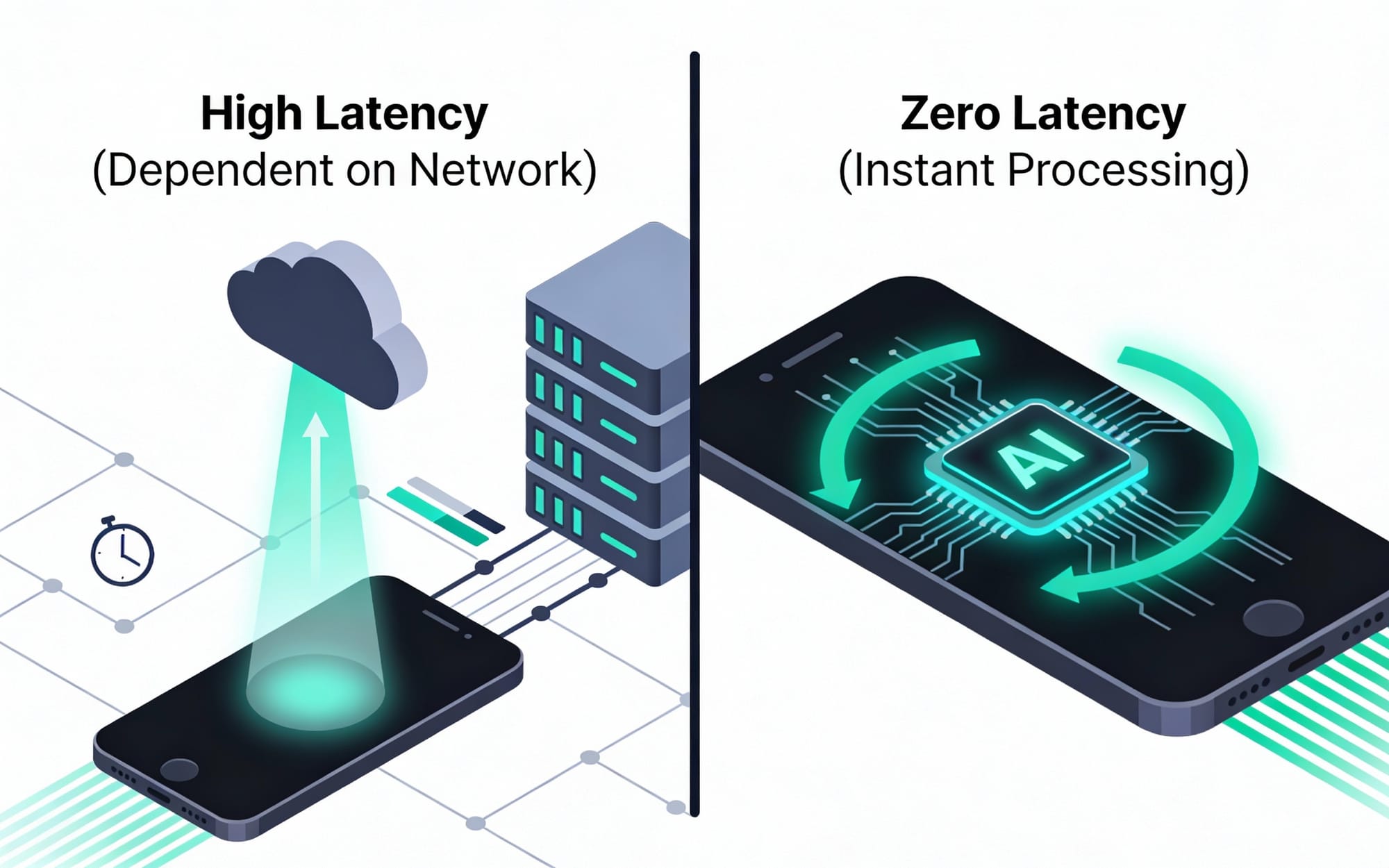
However, this convenience comes with reliance on internet connectivity and potential latency issues.
The Performance Advantage of On-Device AI
On-Device AI, often referred to as Edge AI, is rapidly becoming the preferred choice for high-performance mobile applications. By running machine learning models like TensorFlow Lite or CoreML directly on the user's smartphone, businesses can achieve zero latency performance.
Key Benefits:
- Instant Response: Non-negotiable for features like real-time video analysis, augmented reality, or predictive text.
- Offline Capability: Since data processing happens locally, the application functions perfectly without an internet connection—a significant competitive advantage in areas with unstable coverage.
- Optimized Power: At Codynex, we specialize in optimizing these local models to ensure they deliver intelligent features without draining the user's battery.
Analyzing the Cost Implications
The financial implications of your AI architecture will define your long-term profitability.
- Cloud AI (Variable Cost): Businesses pay a fee for every single API call. While initial development is cheaper, expenses scale linearly with user growth. A viral app can easily rack up thousands of dollars in monthly API bills.
- On-Device AI (Upfront Investment): This shifts the financial burden to upfront capital investment for engineering custom models. However, once deployed, the cost of running the AI is effectively zero because it utilizes the user's hardware.
For high-growth mobile apps, moving inference to the edge is often the most effective strategy for cost reduction.
Privacy and Compliance Benefits
Data privacy has evolved from a regulatory checkbox to a primary consumer demand. Cloud AI architectures inherently require sending user data to third-party servers, introducing potential security vulnerabilities.
The On-Device Advantage:
- Data Sovereignty: Personal data never leaves the user's device.
- Regulatory Ease: This simplifies compliance with strict regulations such as GDPR and HIPAA.
- Trust: By keeping sensitive information like medical records or financial transactions isolated on the phone, businesses can build a higher level of trust with their users.
Hybrid Solutions for Modern Apps
The most successful mobile applications in 2026 often utilize a Hybrid AI Strategy to balance performance and intelligence.
We frequently architect systems where:
Lightweight On-Device Models handle frequent, low-latency tasks (like text auto-complete).
- Powerful Cloud Models are reserved for complex analysis only when needed.
This approach ensures users enjoy a snappy interface while still having access to deep learning capabilities. At Codynex, we have the expertise to audit your specific use case and engineer a balanced solution that optimizes for both cost and user experience.



Comments ()